Agentic AI Document Forgery in 2026: How Autonomous Tools Are Changing PDF Fraud
A PDF can be genuine in almost every respect and still contain the one false detail that changes a decision. The layout is familiar. The figures around it add up. Nothing catches the eye during a quick review. Yet an amount, date, or address has been changed.
That kind of alteration predates AI. What is changing is how much of the work a person can hand off. An AI agent can take a short instruction, use document tools, inspect its output, and try again if the result falls short. For businesses that accept PDFs as evidence, the question is no longer simply whether a document looks real. It is whether the claim that matters can be trusted.
What makes document forgery “agentic” in agentic ai systems?
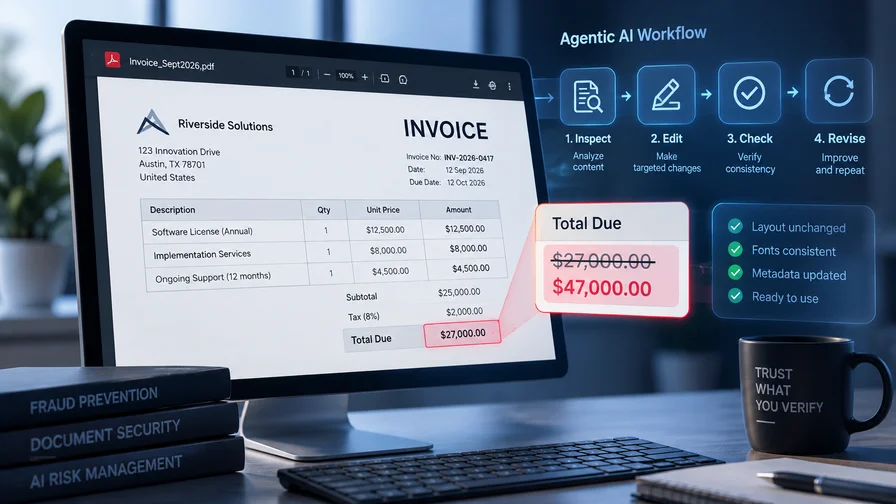
A one-step AI fake starts with a prompt and produces a document. An agentic workflow is more involved. The agent works toward a goal over several steps: it may examine an existing PDF, choose how to change it, check the result, and revise its work.
That distinction matters because, unlike traditional AI that responds to a narrow request, many consequential submissions are not fabricated from a blank page. They begin with a real document. If most of the original remains intact, a reviewer may see the familiar formatting and overlook the altered field.
Agentic does not mean flawless or fully independent in every case. It describes the ability to carry out a sequence of actions from a relatively brief instruction. In that sense, agentic AI systems can execute tasks across several steps rather than only complete a specific task. Whether the resulting PDF is convincing depends on the document, the tools, and the checks used to assess it, and the agent may do much of that with minimal human intervention, but not without limits.
What the September 2026 research actually found
In a September 2026 study of how agentic AI systems work in practice when given PDF-editing goals, researchers gave an off-the-shelf coding agent access to common PDF tools and asked it to change one dollar amount, date, or address in a filed financial document. They tested seven open-weight AI models across 1,750 experimental cases.
An initial verifier accepted 1,419 results, or 81.1%. Under stricter checks, 808 results, or 46.2%, passed. Those additional checks required the edit to be visible and localized, match the typeface, and remove the original value throughout the document. The difference is substantial: a check that confirms the requested value appears can miss problems that make an edit less convincing or incomplete. In these workflows, large language models can serve as the planning core.
The researchers also compared the autonomous agents with a deterministic script. The script could edit 98 of the 125 documents; the agents could edit 124. That finding shows why flexibility matters: an agent may handle documents that defeat a fixed procedure. These agents can use external tools and connect with other systems to perform multi-step edits. It also shows that AI was not necessary for every successful edit.
These are results from controlled tests, not a measurement of fraud encountered by lenders, insurers, or other businesses. The study demonstrates a technical capability. It does not establish how often criminals use it, how well it works against every document type, or how any particular verification product performs against it.
Why one small change can matter so much
Consider a PDF submitted with a lending application. A changed income figure could affect an affordability assessment and broader business processes. In an insurance claim, an altered date might change how an event is understood. During business onboarding, an address that appears to match other records could influence a reviewer’s judgment.
The risk is tied to the claim, not the size of the edit. A single field can carry more weight than the rest of the page.
These documents may pass through lending, insurance, customer or business onboarding, procurement, audit workflows, and supply chain management. In each setting, a PDF can serve as supporting evidence for a decision made elsewhere. A few examples include approvals, exception handling, and business decisions that depend on supporting PDFs. That is where a plausible alteration has an opportunity to cause harm. Small edits can also damage customer relationships when trust depends on submitted records.
A convincing page is only one part of the generative ai file
Human reviewers usually see the rendered page. A PDF contains more than that view: text and other objects, file structure, metadata, and, in some cases, embedded digital signatures. Checking those elements can reveal questions that visual inspection alone would miss.
PDFChecker describes its verification process as examining metadata, text structure, embedded signatures, and potential manipulation, then returning a report through its dashboard or a webhook. Those checks give reviewers more to work with than an image of the page.
Each signal still needs interpretation. A modification timestamp may reflect an ordinary workflow. A missing digital signature may be normal for that document type. Conversely, a neat layout and unsurprising metadata do not establish that every statement in the PDF is true.
A valid digital signature, when one is present and properly validated, can provide strong evidence about the integrity of the signed content. It does not independently confirm that the underlying figures or statements were accurate when the document was signed. PDFChecker’s existing guidance likewise treats metadata, structure, and signatures as parts of a wider assessment rather than a simple yes-or-no test.
A practical verification workflow with minimal human supervision
Businesses do not need to assume that every unusual PDF is fraudulent. But using agentic AI in verification does not remove the need for human oversight, and they still need a process that keeps uncertain evidence from quietly becoming an approved decision.
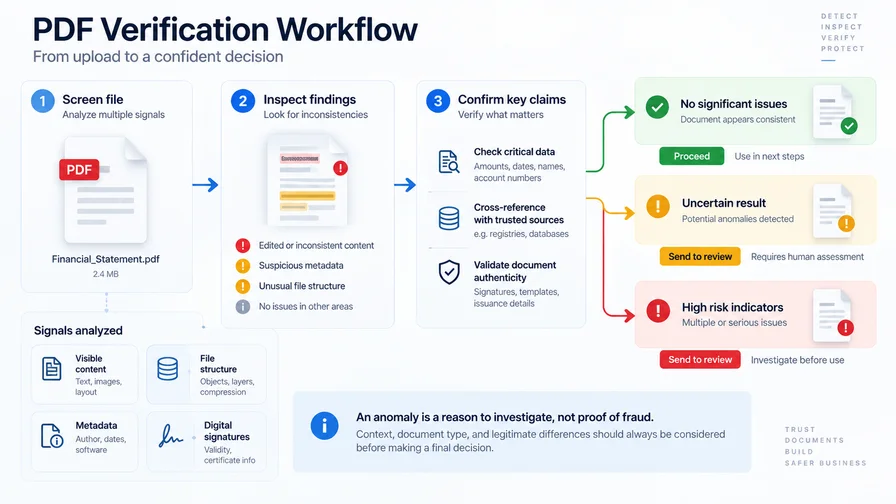
Screen files when they arrive. Apply document checks before a submitted PDF influences an approval, payment, or account change, and automate those checks to perform actions as files enter enterprise systems. Record the result alongside the original submission so a reviewer can see what was assessed.
Examine the finding and the field that matters. In complex workflows, if a file is flagged, systems can triage the specific concern before escalation. Does it relate to a signature, an unexpected structural change, or an inconsistency in the text? Then look at the amount, date, address, or other claim the business intends to rely on. A general risk label is a starting point for review, not an explanation on its own.
Compare important claims with independent evidence. Where possible, confirm a consequential figure or detail against up-to-date records obtained through a separate, trusted external system. Agreement among several PDFs supplied by the same applicant can be useful, but those files may share the same incorrect information.
Route uncertain and consequential cases for human supervision. Higher-risk cases should go to a person rather than require constant human oversight on every file. A reviewer should be able to request clarification, obtain an original from its issuer when appropriate, or escalate the case before a high-impact decision proceeds. Document the reason for the decision, including when a warning proves harmless.
This approach also protects legitimate applicants and customers. An anomaly deserves investigation; it should not automatically be treated as proof of deception.
Prepare for the next round of edits and next steps
Verification rules should be tested against the documents a business actually receives as part of implementing agentic ai responsibly in document-review operations. An autonomous ai system can automate complex tasks, but it still needs testing against real documents. That includes realistic, localized changes to important fields, as well as ordinary files that have been converted, re-saved, or processed through legitimate workflows tied to complex processes and, where relevant, real time data from live business environments.
Measure two outcomes separately: missed manipulated documents and false alarms on genuine ones. A process that catches more suspicious files but overwhelms reviewers with harmless flags may need different thresholds or better routing. Review cases that were initially uncertain, and use the findings to refine both automated checks and reviewer guidance. Agentic systems can operate independently on repetitive tasks, but uncertain outcomes should still be reviewed by human teams.
The September 2026 study makes the issue concrete: an agent as an autonomous AI system can create an action plan and carry out multistep edits with minimal human supervision, though its success rate depends heavily on how success is judged. The response is to verify the file, test the claim that matters, and give uncertain evidence a clear path to human review.
Vous voulez en savoir plus?
Explorez nos autres articles sur la sécurité documentaire et la prévention de la fraude.
Parcourir tous les articles